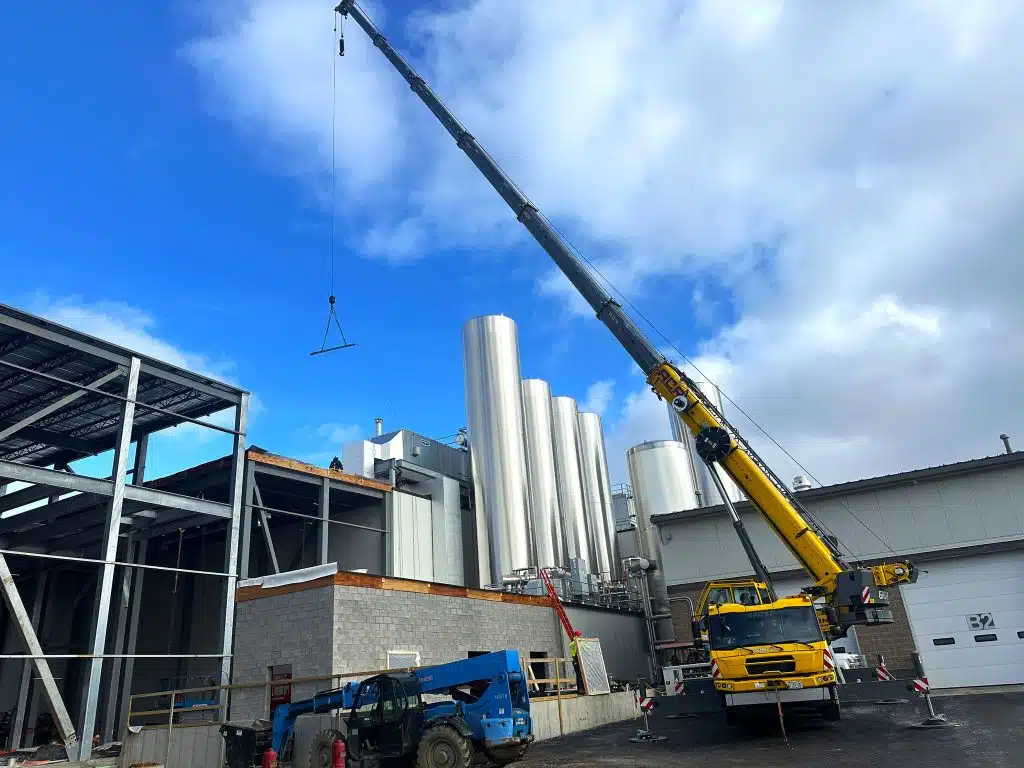
The research and development team at Byrne Dairy has been making progress on developing reduced-sugar flavored milk for schools, thanks to funding from the Northeast Dairy Business Innovation Center. Byrne received a $250,000 grant from NE-DBIC for the project in June 2023.
The project’s objective is to develop a chocolate milk that not only meets the nutritional standards of the National School Lunch Program (NSLP), but also appeals to schoolchildren’s palates.
“Schoolchildren are the future of the country, and it is really important to provide them with nutritionally sound food and beverages. This project aligns with that goal,” said Khilendra Bhanduriya, director of research and development for Byrne.
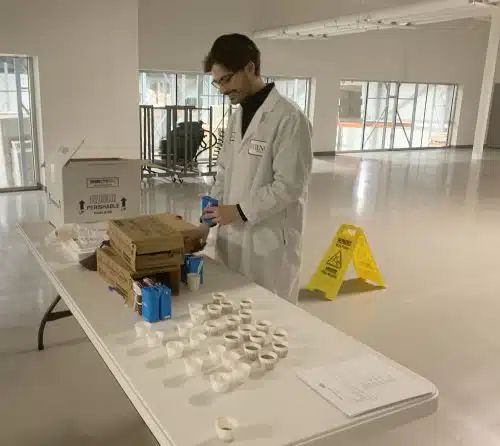
Byrne Research & Development Scientist Zachary Allard prepares chocolate milk samples for students participating in a sensory workshop at Byrne Cortlandville in February 2024. Byrne’s Research & Development department is using grant funding from the Northeast Dairy Business Innovation Center to study reduced-sugar formulations for school milk.
In addition to providing a great-tasting, nutritious beverage for students, Byrne is hoping to improve supply chain and storage challenges for schools by producing aseptic, or shelf-stable, milk.
“Aseptic technology is a new approach that guarantees food safety of the product and also protects the supply chain from the disruptions we have seen recently,” Bhanduriya said.
Many schools currently serve traditional pasteurized milk, which must be kept refrigerated before and after opening. Aseptic technology offers more flexible and sustainable options for storage and logistics, reducing the need for refrigeration.
Headquartered in the Byrne Innovation Center – the newly unveiled, state-of-the-art research and development laboratory – Byrne’s R&D team has spent the last year conducting extensive background research and developing different ingredient formulations.
The team has developed a formula for 1% lowfat chocolate milk that contains 8 to 10 grams of added sugar, compared to 19 grams of added sugar in the original formula.
The product was evaluated by North Carolina State University’s Sensory Service Center and a few local schools. Bhanduriya said the product was “well-accepted” by testers.
In addition to the positive response from testers, Byrne’s new formulation is proving to have great shelf-life 12 months after production. The shelf-life is expected to last a few months beyond this, according to ongoing studies.
Byrne is also exploring further reductions in sugar to 7 grams of added sugar with the use of lactase enzyme. This also makes the product suitable for consumers with lactose intolerance.
Byrne has expanded this study to develop fat-free chocolate milk to comply with nutritional regulations laid out by the National School Lunch Program.